

 rohit
rohit

A tribute to one of India’s most influential modern architects and a key contributor to the Chandigarh Capital Project
Introduction
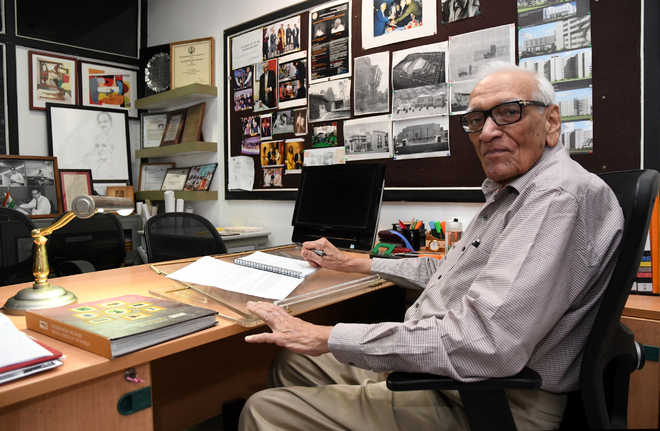
Architect S D Sharma, one of the early team members of the iconic Chandigarh Capital Project led by Le Corbusier and Pierre Jeanneret, has been awarded France’s prestigious Order of Arts and Letters. The honour was presented by the French Ambassador to India, Thierry Mathou, during a ceremony held in New Delhi.
This international recognition celebrates Sharma’s lifelong dedication to modern Indian architecture, his significant role in shaping Chandigarh’s visual identity, and his continuous contribution to cultural and architectural dialogue between India and France.
A Landmark Moment for Indian Architecture
Receiving the Order of Arts and Letters places Architect S D Sharma among an elite global group acknowledged for shaping modern cultural expression. The award highlights the global value of Indian modernism and brings renewed attention to the Chandigarh Capital Project, one of the most important urban design achievements of the twentieth century.
For India, this recognition is a proud moment that underscores the importance of preserving architectural heritage created during the early post independence years.
Early Journey and Role in the Chandigarh Capital Project
Working with Le Corbusier and Pierre Jeanneret
S D Sharma began his architectural career at a time when India was setting the foundation for a new urban future. He joined the original Chandigarh Capital Project team, working closely with Le Corbusier’s office and Pierre Jeanneret. This rare opportunity placed him at the heart of one of the most ambitious planned city projects in the world.
Key Contributions in Chandigarh
During his time on the project, Sharma played an important role in designing and executing several major public buildings, including:
- Government Museum and Art Gallery, Chandigarh
- Museum of Evolution of Life
- Key civic and cultural structures that shaped the city’s identity
These experiences helped him develop a deep understanding of modern urban planning principles while staying rooted in India’s cultural and climatic context.
Influences that Shaped His Architectural Philosophy
Working directly with the pioneers of modernism taught Sharma to combine functionality, climate responsiveness and local materials. His approach evolved into a distinct architectural language that respects modern ideals while remaining practical and culturally aware.
Leadership Beyond Chandigarh
Chief Architect at ISRO
After contributing to Chandigarh, Sharma served as the Chief Architect at the Indian Space Research Organization (ISRO) between 1972 and 1979. His role involved designing research and development facilities that balanced technical demands with environmental sensitivity.
A Lifelong Commitment to Thoughtful Architecture
Throughout his career, Sharma consistently promoted design that blends utility with sustainability. From research institutions to cultural spaces, his buildings reflect a thoughtful approach to material usage, light, ventilation and user experience.
Why France Honoured Architect S D Sharma
France’s Order of Arts and Letters is one of the highest recognitions for contributions to culture, architecture and the arts. Sharma’s selection reaffirms the global significance of his work.
Key Reasons for the Honour
- His role in shaping Chandigarh, a UNESCO World Heritage recognized modern city
- His lifelong commitment to strengthening the heritage of Indian modernism
- His influence on Indo French architectural collaboration
- His impact on future generations of architects through decades of work and mentorship
During the ceremony, the French Ambassador praised Sharma as a visionary who helped shape modern architectural thinking and public space design in India.
What This Honour Means for Indian Architecture
This award brings fresh attention to the value of India’s post independence architecture. It encourages policymakers and urban planners to preserve and promote modern heritage buildings that reflect the country’s historical journey and identity.
It also highlights the importance of architects like Sharma who embraced modernism while staying connected to local needs, climate and culture. His work encourages future professionals to design spaces that are both innovative and humane.
Frequently Asked Questions – (FAQ’s)
Q1: What is the Order of Arts and Letters?
It is a prestigious cultural honour awarded by the French Ministry of Culture to individuals who have made significant contributions to arts, literature or architecture.
Q2: Why was Architect S D Sharma chosen for this award?
He was selected for his role in the Chandigarh Capital Project, his leadership in modern architecture, and his contribution to strengthening Indo French cultural and architectural ties.
Q3: What was his contribution to Chandigarh?
He was part of the original team that worked with Le Corbusier and Pierre Jeanneret and contributed to major buildings such as the Government Museum and Art Gallery and the Museum of Evolution of Life.
Q4: What did he work on after Chandigarh?
Sharma served as the Chief Architect at ISRO, designing several research and development facilities that balanced technical efficiency with sustainable and climate aware architecture.
Conclusion:
Architect S D Sharma’s recognition by the French Government is a milestone for Indian architecture. His career reflects a perfect blend of modernist principles, cultural understanding and sustainable design. The honour not only celebrates his legacy but also shines a global spotlight on the importance of Indian modernism and the need to preserve it for future generations.
His journey continues to inspire architects, planners and students across the world, proving that architecture rooted in purpose and human context can stand the test of time.
